
Bhupinder Malhotra
Director – Industry Studies | Industrial Markets | Strategy | Growth
February 18, 2026
One of the most dangerous assumptions in business sounds perfectly reasonable on the surface: If you understand the technical work of a business, you understand the business itself.
This assumption is not just wrong, it’s fatal.
Research consistently shows that a majority of small businesses struggle within their first five years. While the reasons vary cash flow issues, market conditions, competition the underlying pattern is often the same:
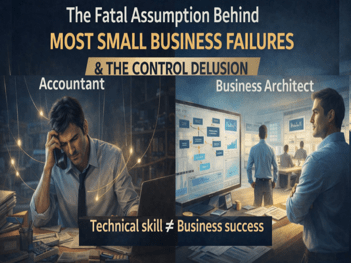
Skilled founders start businesses without transitioning from accountant to business architect. In my experience, this is the real root cause behind many stalled or struggling businesses.
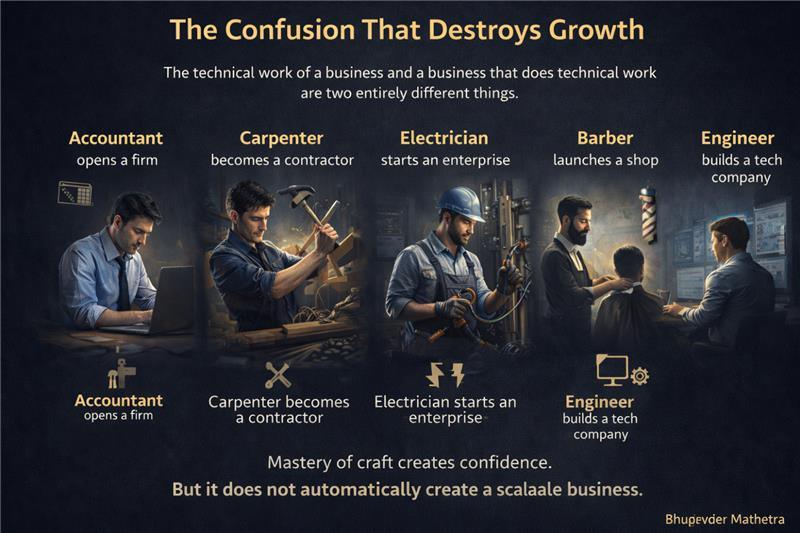
The Confusion That Destroys Growth
The technical work of a business and a business that does technical work are two entirely different things:
- The accountant Starts a business.
- The carpenter becomes a contractor.
- The electrician starts a firm.
- The barber opens a shop.
- The engineer launches a tech company.
Each believes that mastering the craft automatically qualifies them to run the business around it. But what they actually create isn’t a scalable enterprise.
It’s a job with overhead.
They don’t build a business. They create a workplace where they are the most overworked employee.
Studies on founder-led companies show that owner dependency is one of the biggest constraints to scale. When decision-making, execution, and quality control are centralized in one person, growth naturally plateaus.
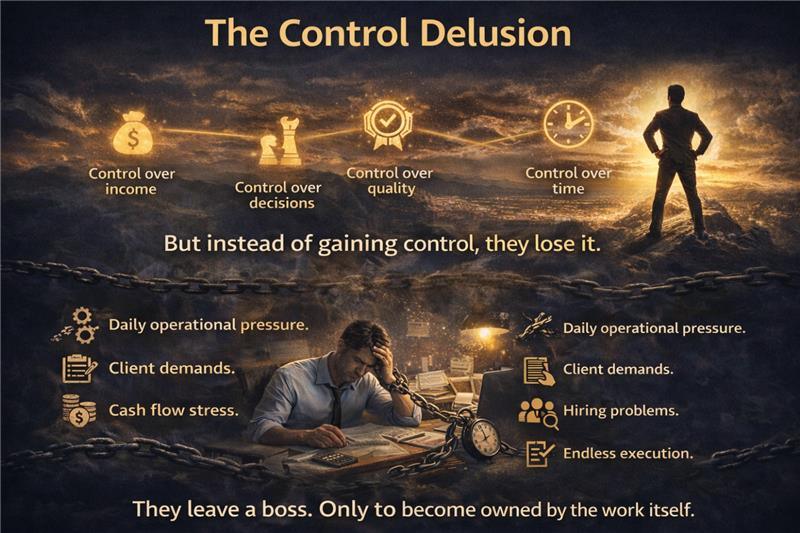
The Control Delusion
This is what I call The Control Delusion. It begins the moment a skilled professional decides to go independent, believing ownership will bring freedom and control:
- Control over income
- Control over quality
- Control over decisions
- Control over time
But instead of gaining control, they become controlled.
Controlled by:
- Daily operational demands
- Client expectations
- Cash flow pressure
- Hiring challenges
- Constant execution
They leave a boss. Only to become owned by the work itself.
The more control they try to maintain over every detail, the more indispensable they become. And the more indispensable they become, the less scalable the business becomes.
That’s the paradox.
Research in organizational design consistently shows that businesses that rely heavily on founder-driven operations struggle to build replicable systems and without replicability, scale becomes unstable.
Skill Is Not Strategy Being exceptional at the work does not qualify you to design the machine that produces the work.
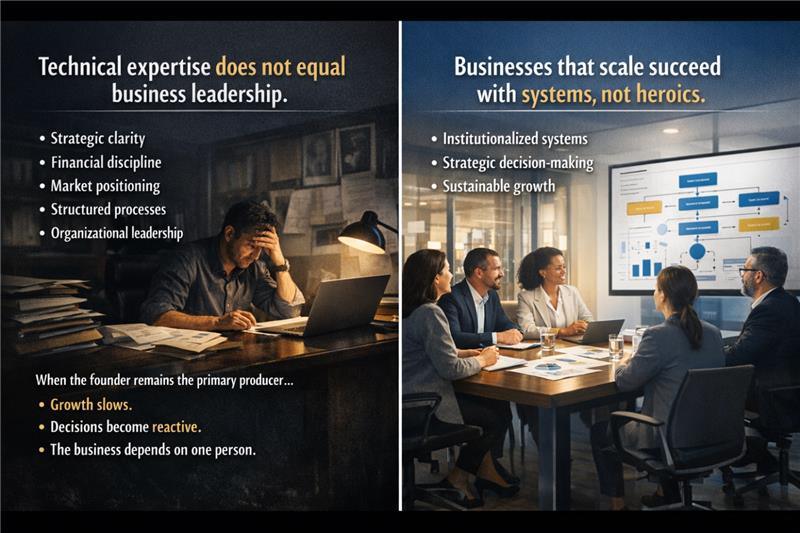
Technical mastery is not the same as:
- Strategic clarity
- Financial discipline
- Market positioning
- Process architecture
- Organizational leadership
When the founder remains the primary producer, three predictable outcomes follow:
- Growth slows.
- Decisions become reactive and emotional.
- The business becomes dependent on one person.
And dependency is fragility. Businesses that scale sustainably almost always institutionalize systems, not heroics.
The “Technical Trap”
When the founder runs the business purely through technical expertise:
- Strategy becomes reactive
- Pricing lacks structure
- Marketing becomes inconsistent
- Hiring decisions are rushed
- Processes remain undefined or weak
- The founder becomes the bottleneck
And The business depends on effort instead of systems.
Technical skill may keep a business alive. But only structured systems allow it to scale and grow sustainably.
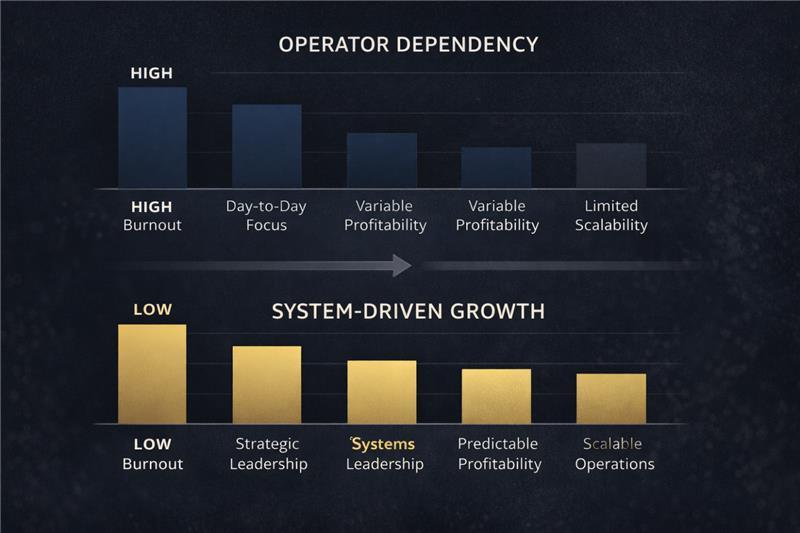
- Without structure, growth becomes chaotic.
- Without clarity, teams become confused.
- Without systems, quality becomes inconsistent.
- And without transition, the founder burns out.
Burnout among small business owners is significantly higher than among salaried professionals not because they lack capability, but because they attempt to operate, manage, and strategize simultaneously.
The Shift That Changes Everything
Real transformation begins with a different question:
How do I build a business that works without me?
- That question forces an identity shift.
From:
Operator.
To:
Architect.
It shifts focus from doing the work to designing the system that produces the work. That is where real control lives. Not in managing every detail.
But in building a structure that consistently delivers results without constant supervision. Organizations that make this transition from founder-dependency to system-dependency unlock true scalability. Control in business does not come from doing everything. It comes from designing systems that work without you.
The moment you become the system, growth stops.
And here is what I have learned after working closely with founders across industries:
- A business built around your effort will always demand more of you.
- A business built around systems will eventually set you free.
Real entrepreneurship begins the day you stop proving your capability and start building capability into the organization.
– By Bhupinder Malhotra