
Bhupinder Malhotra
Director – Industry Studies | Industrial Markets | Strategy | Growth
March 1, 2026
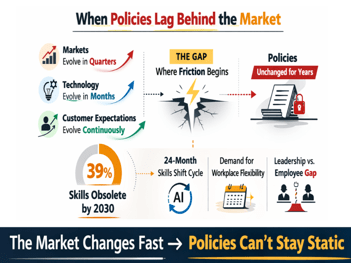
- Markets evolve in quarters.
- Technology evolves in months.
- Customer expectations evolve continuously.
But policies often remain unchanged for years. That gap is where friction begins. This is not a cultural issue It is a policy architecture issue.
Across industries, organisations are experiencing volatility that did not exist a decade ago:
- The World Economic Forum (Future of Jobs Report 2025) estimates that 39% of existing skills are expected to transform or become obsolete by 2030.
- Global workforce research shows skill requirements are shifting within 24-month cycles, particularly with AI-driven capability demand.
- Workplace preference studies consistently show flexibility expectations are now embedded in employee decision-making.
- Perception gap studies reveal significant misalignment between leadership confidence and employee sentiment.
If markets, skills, and expectations move this fast, policies cannot remain static. Yet in many organisations, they do.
The Hidden Cost: Silo Efficiency Policy vs Enterprise Performance
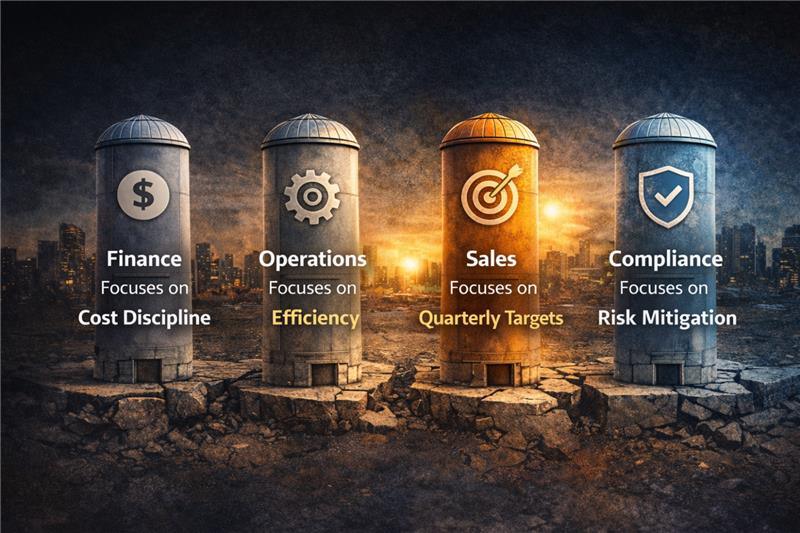
Many organisations unintentionally optimise in silos. Finance focuses on cost discipline. Operations focuses on efficiency. Sales focuses on quarterly targets. Compliance focuses on risk mitigation.
Individually, these look like success. But enterprise performance is not the sum of isolated efficiencies. When policies are designed to optimise each function separately without system-wide alignment organisations experience:
- Conflicting incentives
- Decision delays
- Talent misallocation
- Strategy–execution gaps
Silo efficiency can appear productive. But without integrated policy alignment, it quietly erodes enterprise performance. As “Theory Of Constraints” teaches, optimising parts of a system does not automatically optimise the system itself.
Policies must support enterprise strategy not just departmental metrics.
Production Does Not Automatically Equal Demand
In manufacturing, a factory can produce 24×7 and are encouraged to do so. Vendors can supply in bulk. But if customer demand shifts, staggers and/or the product mix is wrong, inventory becomes misaligned and enormous amount of money is stuck in WIP
Operational efficiency does not guarantee market relevance. The same applies to organisational systems.
If policies are producing:
- Capabilities no longer demanded by the market
- Incentives misaligned with strategic priorities
- Promotions based on tenure rather than adaptability
- Evaluation systems disconnected from behavioural impact
Then the organisation is building internal inventory that may not convert into performance.
The symptoms appear as:
- Work-in-progress overload
- Talent frustration
- Margin compression
- Avoidable attrition
- Slow strategic execution
Losses often stem not from lack of effort but from outdated policy design.
The Governance Gap Is Visible in Data
Global research consistently signals structural misalignment:
- Large perception gaps between leadership confidence and employee experience
- Accelerated transformation of required skills
- Increased demand for adaptability and cross-functional collaboration
- Strong preference for flexible operating models in remote-capable roles
When leadership assumes stability but the environment is dynamic, policy modernisation gets delayed. And delay is expensive.
Outdated policies rarely fail dramatically. They fail quietly , through friction.
Why Policies Become Obsolete
Most policies are built for:
- Risk control
- Predictability
- Stability
Those are valid goals in low-volatility environments. But when volatility increases, the very mechanisms designed to protect the organisation can restrict it. Stability becomes rigidity. Control becomes delayed. Standardisation becomes stagnation. And rigidity feels like friction across the system.
What Modern Policy Architecture Looks Like
High-performing organisations share common design principles:
1. Alignment to Future Demand
Policies are built around where the market is going not where it has been.
2. Integrated Incentives
Metrics across functions reinforce the same strategic outcomes.
3. Behaviour + Results
Performance systems evaluate not only output, but collaboration, adaptability, and ethical conduct.
4. Continuous Review Cycles
Operating rules are reviewed annually or sooner if triggered by:
- Market shifts
- Capability disruptions
- Regulatory updates
- Technology acceleration
- Attrition spikes
Governance becomes a dynamic capability not static documentation.
A Practical Rule for Any Business
Review core policies every 12 months. Treat it as governance hygiene not crisis response.
Trigger earlier reviews when:
- Market conditions change materially
- Skill requirements accelerate
- Hybrid or operating models shift
- Engagement or retention patterns decline
- Strategy pivots
Policy review should be proactive, not reactive.
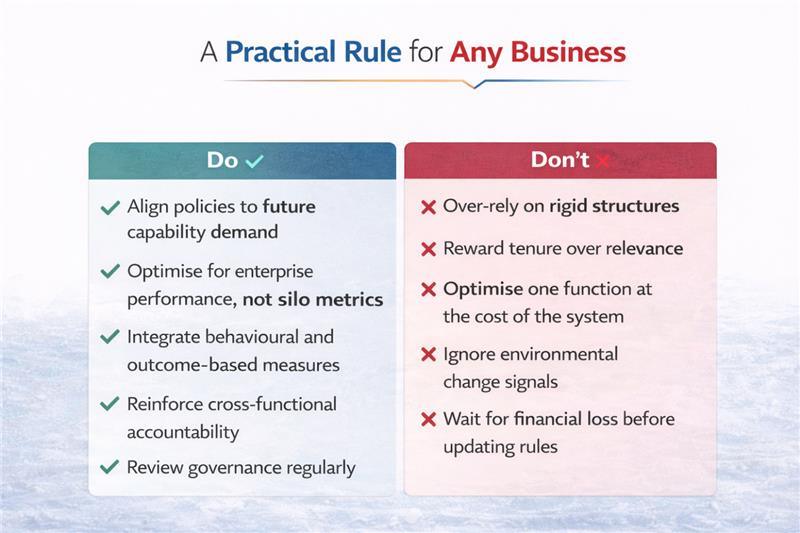
Do
- Align policies to future capability demand
- Optimise for enterprise performance, not silo metrics
- Integrate behavioural and outcome-based measures
- Reinforce cross-functional accountability
- Review governance regularly
Don’t
- Over-rely on rigid structures
- Reward tenure over relevance
- Optimise one function at the cost of the system
- Ignore environmental change signals
- Wait for financial loss before updating rules
The Strategic Reality
Outdated policies do not usually create visible crises.
They create:
- Slower execution
- Confused accountability
- Reduced adaptability
- Margin erosion
- Talent leakage
- Competitive decline
Modernising policies is not administrative maintenance. It is competitive positioning. In volatile markets, the organisations that rise are not the ones with the most resources. They are the ones whose systems evolve at the speed of change. Governance is no longer about control.
It is about alignment. And alignment is strategy. Strong organisations are not built only on strategy. They are built on systems that evolve as fast as the market. When policies stay relevant, performance stays sustainable.
-Bhupinder Malhotra