
Bhupinder Malhotra
Director – Industry Studies | Industrial Markets | Strategy | Growth
February 13, 2026
When something feels off in a business, the instinctive response is almost automatic:
- “We need a new CRM.”
- “Let’s implement an CRM.”
- “The problem is visibility.”
But the data tells a different story.
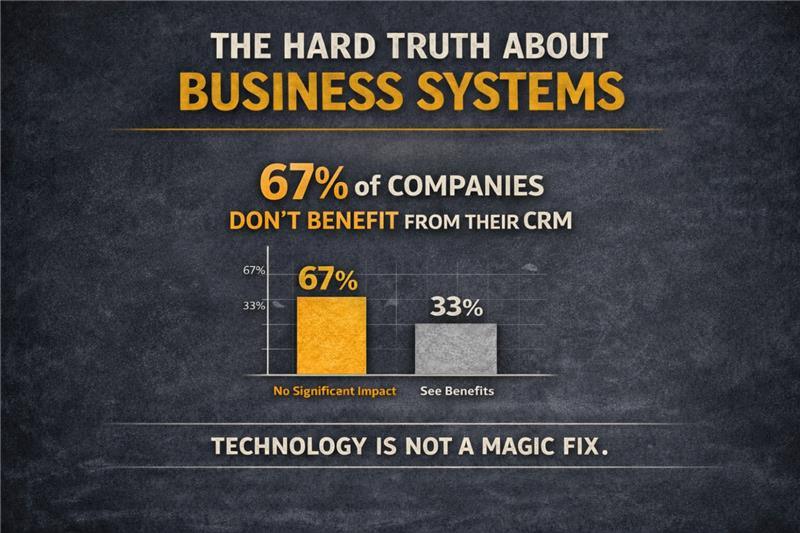
67% of companies don’t see meaningful benefits from their CRM.
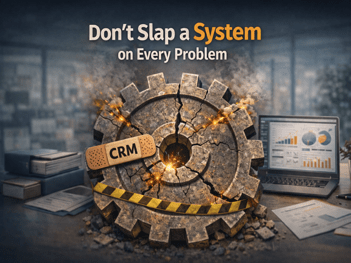
These aren’t technology failures. They’re thinking failures. Imagine a broken gear in a machine. Slapping a bandage on it even one labeled CRM doesn’t fix the problem. It only hides it for a while. This is a mistake I see repeatedly in growing organizations.
Systems do not create clarity. They can expose whatever already exists. Before investing in any system, leaders need to pause and ask a more fundamental question:
- What exactly are we trying to execute?
- Start With Strategy, Not Software
- What is your competitive advantage?
- What real problem are you solving and for whom?
- Who is my customer? More importantly ” Who is not my customer ?”
- How do i create a leverage?
- How will i reach out to my customer? What’s my marketing strategy?
If these answers are unclear, no software will define them for you.
Technology cannot replace strategic thinking. Most failed CRM implementations aren’t missing features. They’re missing direction.
Then Define Sales Properly
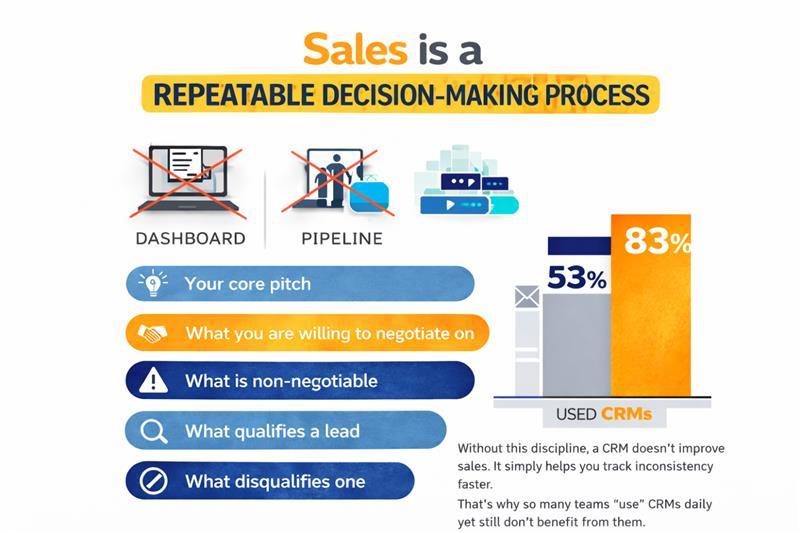
Sales is not a dashboard. It’s not a pipeline. And it’s definitely not a list of deals sitting in a tool.
Sales is a repeatable decision-making process. Before implementing a CRM, you should already know:
- Your core pitch
- What you are willing to negotiate on
- What is non-negotiable
- What qualifies a lead
- What disqualifies one
- Without this discipline, a CRM doesn’t improve sales. It simply helps you track inconsistency faster.
That’s why so many teams “use” CRMs daily yet still don’t benefit from them.
They lock in poor habits and make them harder and more expensive to change. That’s how companies end up using only a fraction of what they paid for.
What Systems Actually Do
CRMs are not solutions They are force multipliers.
They amplify what already exists:
- Unclear strategy gets scaled
- Weak processes get exposed
- Confusion becomes visible
A CRM will not fix a broken system. But it will amplify the cracks.
Let’s Fix the ” Thinking” first let technology support execution not replace direction.
— Bhupinder Malhotra